Iron Cycles has blog has moved!

You should be automatically redirected in 4 seconds. If not, visit
http://www.ironcycles.com/blog/
and update your bookmarks.

Monday, April 16, 2012

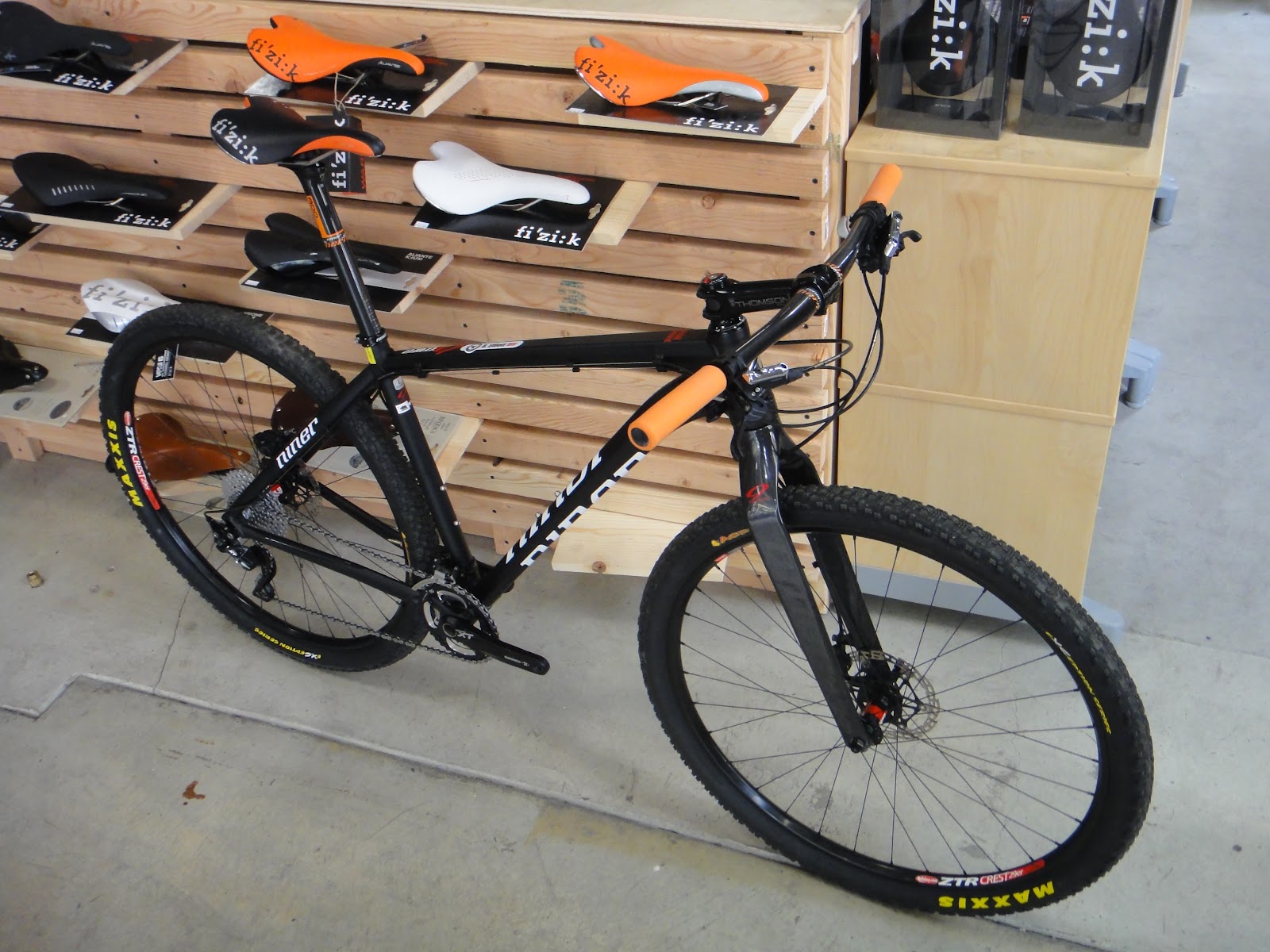
On test: 2012 Niner EMD9

It's no secret I've been a fan of 29ers for quite some time.  My first one dates back to roughly 2006 with a Salsa Mamasita, and I was instantly in love.  That bike was built with an entry-level REBA, X9, and some cheap wheels.  I can't say I remember for sure, but I'd guess it was north of 27-28 lbs.

29ers have changed quite a bit since then.  I'm still riding alloy, though I've ridden plenty of titanium and carbon since then.  At the end of the day, I have a tough time faulting aluminum for it's killer price point, relatively light weight, durability, and great looks.

For 2012 Niner has updated the EMD9.  It may be their entry-level frame, but the specs are right.  It's ready for a tapered steerer tube, which I took advantage of with a SID XX fork.  The standard 73mm English bottom bracket was a welcome spec as I was planning a the use of Shimano cranks.


Like all other frames from Niner, the EMD9 came out of the box perfectly prepped.  Bottom bracket threads were tapped, the bottom bracket and head tube and rear brake mount had been faced.  All great touches that save us a ton of time.

The finish on the frame is a really nice semi-matte black with white logos.  Totally understated and certainly my style.  Add in a few orange touches and this becomes the perfect Iron Cycles team mountain bike, which would explain the abundance of them on our team.


Specs on this build:

Niner EMD9 frame, black, large
Rock Shox SID XX World Cup tapered fork, 15mm Maxle
Shimano XT drivetrain
Niner RDO carbon seatpost
Thomson Elite X4 130mm x 0* stem
Niner RDO carbon handlebars
Fizik Aliante custom saddle
Stan's NoTubes Crest wheelset, XTR 15mm front hub, PowerTap rear hub
King Cages stainless cages
Maxxis Aspen tires


In the first week of having this bike built, I've logged roughly 8-9 hours on the trails.  Comparing this to the Air9 Carbon I recently rode the EMD9 performed admirably.  The AIR9 Carbon's head tube MAY be a hair stiffer, and the BB junction MAY be a hair stiffer, but in all the EMD9 was right on par with the AIR9 Carbon at roughly 1/3 the price.  The EMD9 does give up to the AIR9 Carbon in the weight department, but this built built to only be 2 lbs heavier with a heavier gruppo on it as well.

One worthwhile upgrade that I can't recommend enough is the 15mm Maxle fork.  Be it a suspension fork or a rigid one, if you have the option to run a 15mm Maxle, DO IT!  The stiffness increase was immediately apparent and totally welcome.  The weight penalty is minimal, and is more than made up for on the first rock garden or errant root you come across.

I plan to put plenty of trail time on this frame and fork, and I'll be sure to report back often on it.  So far, I'm blown away that a frame that retails for $550 can be so good.  Yes, it's aluminum, so it may not be as sexy as the newest carbon offerings.  But the weight is reasonable, the ride quality is great, and the price is nearly impossible to beat.

Time to get out and ride some more....

Sunday, April 15, 2012

NEW BIKE DAY! Surly Cross-Check Custom

Surly is a brand that's near and dear to us.  Bikes made to do work, flexible in design, reasonably priced, and built with quality.  The complete builds are really a steal, but what makes Surly so special to us is how easily they can be customized.  Buy any model as a complete bike or a frameset to start and go from there.

This particular one only has slight modifications from stock.  A Brooks B17S saddle, matching Brooks leather bar tape, Michelin City 700 x 32c tires, and a 42cm FSA Omega Compact bar make this bike even more city friendly than before while also adding (not a small amount) of comfort for the long rides.

The drivetrain was kept stock, and for good reason.  The bar end shifters are bomb-proof, and everything on the bike was built to last.  Since this bike was built to be ridden, a lot, the stock drivetrain made tons of sense.
The Brooks B17S saddle that was added is so subtle in black, but so absolutely beautiful.  It perfectly compliments everything this bike is about.
The Brooks Leather bar tape was a touch we took upon ourselves.  The tape of course matches the saddle perfectly, but it also adds a nice touch of class to the front of the bike.  It doesn't hurt that it'll also last forever.

There you have it.  Small touches, small changes, and the bike becomes something all it's own.

Independent Fabrication Steel Club Racer

Steel, custom, ready for anything,  Do they get better?

Independent Fabrication Adventure Bike

Subtle, beautiful, functional.

Tuesday, April 10, 2012

2012 Felt DA3 Review

Our boy Henry sent this one on to me.  We recently built his DA3 for the upcoming tri season, though the bike will also see plenty of time trial duty as well:

Last fall, following my final triathlon of the year (Ironman Wisconsin) I made up my mind I’d be upgrading in the bike department.  For all of 2010 and 2011 I raced a Cannondale Slice 5.  The Slice was in fact my first tri bike, purchased in January 2010.  While I was happy with it, I wanted to step up to a bit nicer bike and also give myself a bit more flexibility with the fit.  This was mainly based on having more fitness and being approximately 15 lbs lighter than when I was fit for and purchased the Slice.  My first call was to Brandon at Iron Cycles, to throw around a few ideas on bikes.


The last couple of years, lots of companies have introduced new triathlon “superbikes.”  A few caught my eye, specifically the Trek Speed Concept and the Felt DA.  While Trek decided to offer two primary models of the SC, the 7 and 9-series, each of which you can modify the specs on, Felt went a slightly different direction and one that was attractive to me.  Felt’s top-of-the-line tri frame has been the DA for several years.  Beginning in 2012, Felt offered multiple variations on same frame design, similar to how they’ve previously marketed the B-series (which shared the DA mold up until 2011).
For 2012, Felt now offers the DA1 and DA1 frameset, which are top dogs in the Felt lineup.  

However, with some changes in spec and a switch from 1KP weave carbon fiber (DA1) to 3KP weave (all other DA models), a consumer can see some pretty serious bang-for-the-buck with the DA2, DA3 and DA4.


After talking with Brandon and some deliberation on my own, I decided on the DA3.  All the details are on Felt’s site so I’ll keep it brief, but the component mix is top of the range for mechanical shifting: SRAM Red derailleurs in front and back, Red TT chainrings, Zipp VukaShift R2C carbon shifters and Felt’s proprietary aero-optimized brakes.  The front caliper has an anodized red fairing wrapped around it to help shield it from the wind, while the rear brake is hidden under the frame, just behind the bottom bracket – a standard on most tri superbike models these days, but pretty slick nonetheless.  The stock cockpit setup on the DA3 is Felt’s bayonet alloy basebar, with carbon f-bend extensions.  I opted to swap in a Bontrager Race X Lite handlebar, which replaced both the basebar and extensions, but the Bayonet and f-bends are highly regarded for their aerodynamics and usability.  This was based on personal preference for a different extension style and feel, though I did try the Felt pieces first.  I’d recommend the same to anyone switching to Felt from another manufacturer, as their bars and extensions really are good equipment.


One final change I made was adding a Quarq power meter, which necessitated a change in crankset to the SRAM S900 crank matched to the Quarq.  While I’ve been training with power on the road since fall 2010, I wanted to upgrade to a crank-based option to have more flexibility in wheel choice for training and racing.


So enough of the details — let’s fast forward to how this thing feels out on the road.  While I could contrast the DA3 with the Slice or my road bike, I don’t think it’d be a fair, apples-to-apples comparison.  Thus, I’ll just share my observations from a 3 hour ride on the roads outside Madison, WI recently.

First off, the bike is light.  Not feathery light, but Felt’s Inside Out molding process must does seem to have resulted in a nicely balanced frame – light yet stable.  The true nature of the DA is revealed when you are in the aerobars, head tucked and pushing a big gear.  One word will cover it here: FAST.  Even riding into a headwind, being in the aero position on this bike feels almost like cheating — it really does feel like you’re knifing through the air.  Having also spent time on an Orbea Ordu, which has a notoriously stiff ride, the DA3 is at least its equal.  The frame is forgiving on the chipseal roads found in the farmland of the Midwest, yet it’s also very responsive when stomping the pedals to sprint on a flat or climb a steep grade.  The Red TT chainrings definitely lend themselves well to power transfer too, given the solid construction of the big ring, which again becomes evident when really working a climb.  Three hours in the saddle and I was very comfortable and excited — it’s a very good thing when a long outdoor ride on a new bike doesn’t leave you sore in all the wrong places.

Something else I noticed about the new DA is that it handles quite well for a triathlon bike.  Obviously, handling on a tri frame has to be considered in relative terms, because it will never feel as nimble as a road bike nor should it.  The DA is designed with its primary goal in mind: go fast in a straight line.  However the DA felt very stable at speed, willing to dive into corners.  At first I was tentative on the new bike, but after a short time I really started to lean into a few descents.  With my outside foot planted, the DA just stuck to the road and zipped down the backside of each hill and toward the apex of every turn.  The steering wasn’t twitchy at all, so I was comfortable starting to explore the limits of the bike (which certainly exceed my own bike handling skills).  This isn’t breaking new ground, but the Zipp VukaShift shifters were new to me, but felt very natural in-hand.  The SRAM Red drivetrain did just as I expected, which is to say the rear shifts were quick and crisp, while the front shifts were much the same and nary a dropped chain.


My day was complete with an easy spin the last few miles, with my time spent reflecting on my first long ride on the new DA3.  I’m really happy so far and can’t wait to spend more time on the bike.  I’ll be riding it in an upcoming time trial, not to mention my triathlon race season which kicks off in just over a month.  The DA will have me ready to tear up some bike courses.  I’d highly recommend checking out any of the models in the DA lineup to anyone considering a new triathlon bike, as Felt certainly has price points to fit most budgets.  The guys over at Iron Cycles are one of the only Felt dealers in Chicago, not to mention some of the most knowledgeable and easy-to-work-with folks around.

A special thank you to Brandon, Steve, Ben and Chase at Iron Cycles for their help with the new whip!

Thanks Henry!  And check out his blog here for more endurance ramblings....

Niner EMD9 w/ 2012 Shimano XT

This one was a pleasure to build, because well, it's mine.  I previously had built an EMD9 but it's since been sold.  I loved the frame enough that I just replaced it with an identical one.

For the first time for me, I decided to build it with a Shimano build kit.  I spent some time chatting with some mountain biking friends who do some "real" riding, you know, in the mountains.  The consensus was easy to gather: Shimano XT brakes are the best.  I heard from many of them that XTR works just as well, but at a far higher cost.

Since I was going with XT brakes, I stuck with the full XT kit.  Shifters, derailleurs, cranks, chain, and cassette are all XT.  The fork is a Niner carbon unit, bars and post are also Niner carbon, the post is the RDO version.  The stem is ole faithful, a 130mm Thomson X4.

Wheels were hand built Stan's NoTubes Crest laced to DT Swiss 240s 6-bolt disc hubs with DT Swiss Revolution spokes 3x and DT Swiss ProLoc brass nipples.

Price as built?  $3700 out the door for a pure-bred race bike.


Friday, April 6, 2012

Independent Fabrication Steel Club Racer w/ SRAM Rival

On a completely opposite end of the paint spectrum from our last IF, we have this super-stealth Steel Club Racer.  While similar in construction, both are steel with steel forks and made in Somerville, this one opted for no logos at all other than the IF Crown headtube decal.

Also particularly awesome about this bike is the added clearance the Club Racer brings to the table.  With enough room for 28's easily, and maybe even some smooth 32's from certain brands, this bike is ready for good roads and bad.

We should point out that even though this bike has seen a ton of miles, the first generation SRAM Rival is still kicking!  I don't care to even imagine how many shifts it's seen in it's lifetime, but the polish remains nearly perfect and the shifting action is flawless.  What I wouldn't give for some silver Rival stuff right about now....